Studio Notes
A Fascinating Little Trick Our Minds Play on Us
How painting changes what we notice, and sometimes even what we love.
By Celine · · 4 min read
Have you ever noticed that when you buy a red car, suddenly there seem to be red cars everywhere? You see them at traffic lights, in parking lots, on your way to the grocery store. Were there always this many red cars around? Well, probably.
Apparently, there's a name for this: the Baader-Meinhof phenomenon, also known as the frequency illusion.
It's a fascinating little trick our minds play on us. Once something catches our attention, we begin noticing it everywhere. It's not necessarily that there are more red cars on the road. It's just that our brains have started paying attention to them.
I've been thinking about this lately because I've realized that something very similar happens to me when I paint. Except there's an interesting twist. The more I paint something, the more I notice it. And sometimes, the more I notice it, the more I actually begin to like it.
And Then, Somehow, There Were Dogs
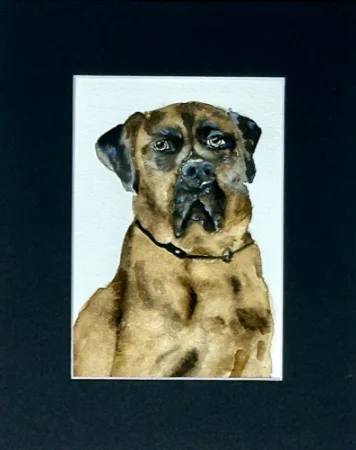
I'm not entirely sure how my dog-painting phase began. Maybe I saw a photograph of a dog with a particularly funny expression, or maybe I just wanted to try painting something different. Whatever the reason, I started painting dogs. And then I painted another one, and another. Before I knew it, I was studying dog faces, trying to capture their expressions, personalities, and those wonderful little looks they give you.
Some dogs look permanently worried. Others seem convinced they're in charge of absolutely everything. And some have that expression that says, "I have no idea what happened to your sandwich." There's a lot of personality in a dog's face, and the more I painted them, the more I started noticing dogs in real life.
Suddenly, every dog I passed on the street caught my attention. I'd notice how they walked, how they tilted their heads, or the way they looked at their owners. And here's where things got interesting: I actually started liking dogs more.
Now, this might not sound particularly surprising, except for one small detail. I've always considered myself a cat person. I love cats, their independence, their attitude, the way they can look at you as though you're the one who has wandered into the wrong house. Cats have always made sense to me.
But somehow, after spending so much time painting dogs, I've developed a whole new appreciation for them. I find myself smiling at dogs I pass on the street. I notice how expressive they are, and I even catch myself looking at dog pictures just for fun, not necessarily because I'm planning to paint them.
So, am I becoming a dog person? I'm not ready to make any official announcements. The cats might take it personally.
Maybe We Don't Just Paint What We Love
This whole experience got me thinking. We usually assume that artists paint things because they love them. You love animals, so you paint animals. You love landscapes, so you paint landscapes. And of course, that's often true. But what if it sometimes works the other way around? What if spending time painting something actually makes us appreciate it more?
When you're painting a dog, you begin to study its expression. You notice the personality in its eyes, the tilt of its head, the way a few small details can make one dog look completely different from another. And once you've spent time really looking at something, it's hard to go back to not noticing it.
Psychologists might explain some of this through selective attention. There's also something called the mere-exposure effect, the idea that becoming more familiar with something can sometimes make us like it more. I find that combination rather fascinating.
Of course, painting something repeatedly doesn't guarantee we'll fall in love with it. But I've certainly noticed it happening to me. Maybe painting doesn't just reflect what we love. Maybe it actually teaches us what to love. I rather like that thought.
Seeing Things a Little Differently
What I find most interesting about all of this is that painting has changed the way I look at the world, even when I'm not holding a brush. I notice colors more. I pay attention to shapes, expressions, and little details I might otherwise overlook.
A dog sitting outside a café becomes an interesting study in expression and personality. Even a shadow on a wall can make me stop for a second and think about how I might paint it. I don't always do anything with these observations. Not everything needs to become a painting. Sometimes it's simply nice to notice.
And perhaps that's what I enjoy most about being creative. It gives me another way of looking at ordinary things. The world hasn't necessarily changed, but what catches my attention has. Just like those red cars.
As for whether I'm now a dog person or a cat person? I think I'll keep painting both. There's no need to complicate things.
And who knows? Maybe tomorrow something completely different will catch my attention. That's the fun of it.
Thanks for stopping by. I hope this little story inspires you to notice something you might otherwise have walked right past.