Tutorials · 7 min read
How to Paint Watercolor Grapes: An Easy 7-Step Tutorial
By Céline · August 11, 2026
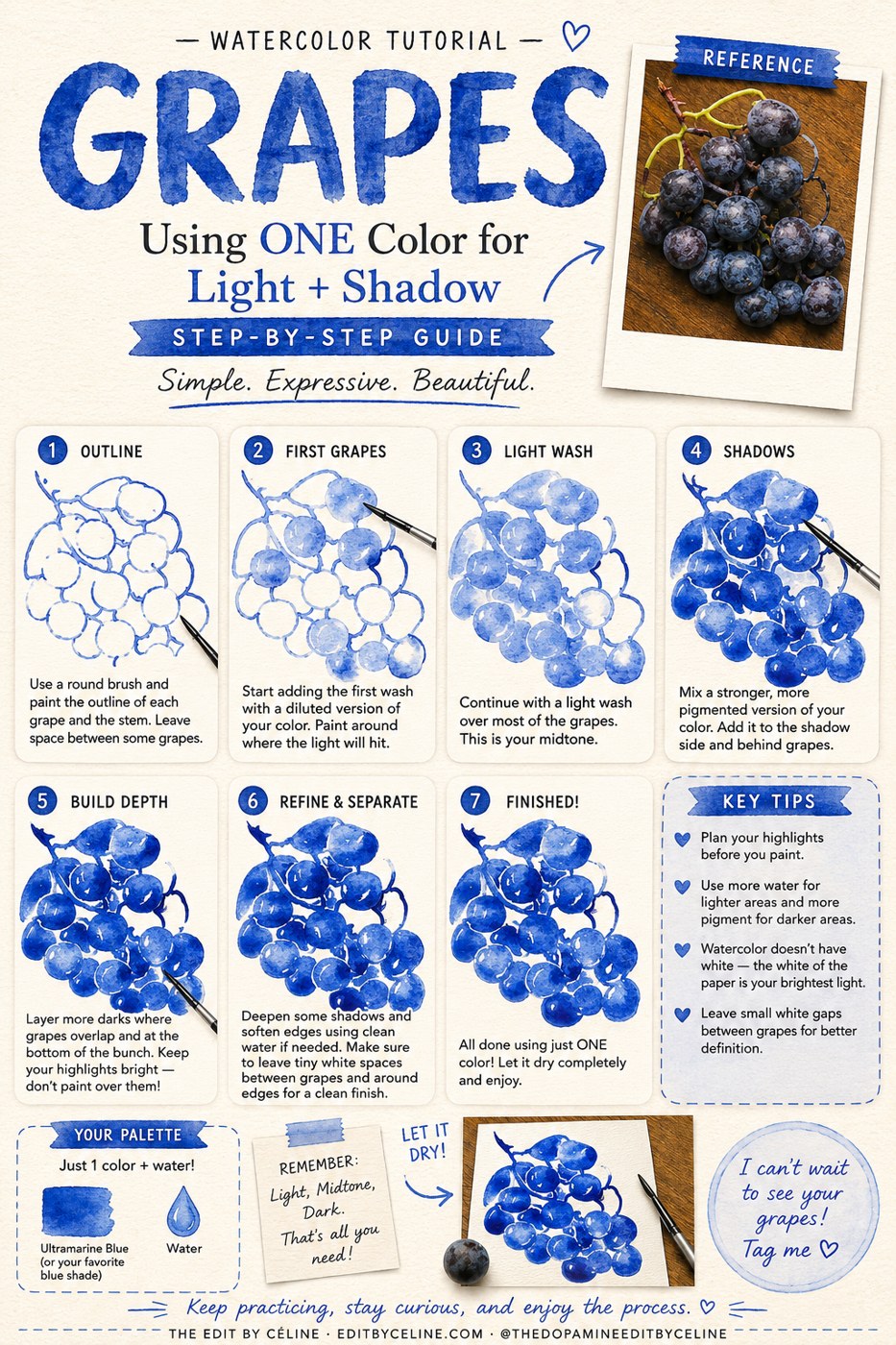
Grapes are my favourite way to teach round shapes. Every berry is the same little exercise repeated — wet circle, drop of colour, leave it alone — and by the time you reach the bottom of the bunch your hand has stopped fighting the brush. This is the exact sequence I use in the studio, in seven steps.
What You'll Need
- Cold-press watercolor paper, 140 lb / 300 gsm — anything lighter will buckle.
- A round brush, size 6 or 8, plus a smaller size 2 for stems.
- Three colours: a violet-purple, a warm red, and a sap or olive green.
- Two jars of water — one to rinse, one to keep clean.
- Paper towel for lifting, and a pencil if you like to sketch first.
Step 1 — Outline the Bunch
Draw overlapping circles in a loose triangle, wider at the top and tapering to a point. Don't measure. Let some berries hide behind others — the overlaps are what make it read as a bunch instead of a pile of balls. I outline in dilute blue paint rather than pencil so the lines melt into the painting later.
Step 2 — First Wash
Paint every other berry with a light violet wash, skipping the ones that touch. Skipping matters: two wet neighbours will bleed into one blob. Once the first set is dry to the touch, come back and fill the gaps.
Step 3 — Build the Second Layer
Mix your violet with a touch of warm red and drop it into the lower half of each berry while the first wash is still damp. The colour will creep upward on its own and settle into a soft gradient. That gradient is the whole illusion of roundness — you're not shading, you're letting water shade for you.
Step 4 — Add the Shadows
Now the strongest mix, almost straight from the pan. Paint a thin crescent where each berry tucks behind another, and darken the berries deepest inside the bunch. Two or three dark contact points are plenty; shadow everything and the bunch goes flat again.
Step 5 — Lift the Highlights
While a berry is still slightly damp, touch a corner of paper towel to its upper left — the same spot on every berry, so the light stays consistent. If the paint has already dried, wet a clean brush, scrub gently, and blot. That one small dot of white paper is what makes grapes look glossy.
Step 6 — Leaves and Stem
Two leaves, one large and one half-hidden, painted wet-on-wet in green with a drop of your purple dropped in at the base so they belong to the same painting. Then the stem in your small brush: one confident curve, thicker at the top, thinner at the tip. Don't retrace it.
Step 7 — Finish and Sign
Let everything dry completely, then look at it from across the room. Usually one more dark accent between two berries is all it needs. Sign it small in the lower right and stop — the hardest step in watercolor is deciding you're done.
If you'd rather hang a finished one, I paint originals in the same palette — have a wander through the Food & Sweets collection.
Frequently Asked Questions
Why do my grapes bleed into each other?
Because neighbouring berries were wet at the same time. Paint every other berry first, let that pass dry, then fill in the gaps.
What colours make a realistic grape purple?
A violet base warmed with a touch of red for red grapes, or cooled with a whisper of blue for darker ones. Mixing two pigments always looks more alive than one straight from the tube.
Do I need special paper?
Cold-press 140 lb / 300 gsm is the sweet spot. Thinner paper buckles and dries in hard blooms, which fights the soft gradients this exercise is built on.
How long does each layer take to dry?
Five to ten minutes in a normal room. If the paper still looks shiny, it's wet — wait. A hairdryer on low from a distance is fine between layers.